Court of Heaven: What It Is and What Scripture Says
You keep hearing believers pray "in the court of heaven" and something in you leans forward. Maybe you're facing a situation with your child, your marriage, or your own health that feels stu...
You keep hearing believers pray "in the court of heaven" and something in you leans forward. Maybe you're facing a situation with your child, your marriage, or your own health that feels stuck in a spiritual gridlock, and you sense that ordinary prayer isn't reaching whatever is holding it in place. That instinct isn't wrong. Scripture describes a real, functioning court of heaven, and understanding it changes how you pray.
So what is the court of heaven? It's the biblical picture of God as righteous Judge, presiding over a heavenly tribunal where accusations, verdicts, and legal decrees are made concerning your life. Daniel saw it. Job stood before it. Understanding this framework helps you see why the Bible so often uses legal language, like advocate, witness, and testimony, when describing prayer and redemption.
In this article, we'll walk through the court of heaven scriptures that establish this concept, unpack what's actually happening when believers pray this way, and show you how to approach it with confidence rather than confusion. If you want to go deeper after reading, the Court of Heaven Defense Protocol course walks you through this practice step by step.
Why the court of heaven matters for your prayer life
Most Christian mothers learn to pray by asking. You ask God to heal your daughter, to soften your husband's heart, to protect your son from the friends pulling him toward trouble. That's real prayer, and God hears it. But sometimes you sense there's something more legal happening behind the scenes, some accusation or claim that keeps blocking the answer you're asking for. The court of heaven framework names that reality directly: certain battles aren't just about asking a Father for help, they're about answering an accusation before a Judge.

When petition prayer feels stuck
Sometimes you pray the same prayer for months, even years, and nothing shifts. You've confessed every sin you can think of, you've forgiven everyone who's hurt you, and still the oppression around your child or your marriage doesn't lift. Scripture suggests a reason this happens: Satan functions as an accuser, bringing charges against you and your family in a real courtroom, a picture drawn directly from Revelation 12:10. If a legal accusation stands against you, no amount of asking resolves it on its own. You need a verdict, not just a request.
Some battles in your life aren't solved by asking harder. They're solved by answering the accusation standing against you.
The legal reality behind your circumstances
Understanding what is the court of heaven reframes stubborn situations you've been praying about for years. Job's suffering wasn't random; Job 1 shows Satan standing before God, making a specific legal claim about Job's motives and integrity. Job never saw that courtroom scene play out, but the moment it resolved, his circumstances changed completely. Your situation may carry a similar unseen legal component: words spoken over you, generational patterns, broken agreements, or accusations rooted in real or perceived sin. Naming this doesn't mean every hardship is a courtroom drama, but it does mean you stop assuming stuck prayers simply reflect insufficient faith or bad timing.
What shifts once you understand the courtroom
Once you grasp that God is Judge as well as Father, your prayer language changes. You stop merely asking and start presenting evidence, appealing to what's already legally true because of Christ's finished work. This isn't a gimmick or a formula guaranteeing outcomes; Warrior Mom is careful never to promise a specific result from any prayer practice. It's a posture shift, from a child begging in the dark to a redeemed believer standing on settled legal ground.
Here's how the two postures typically differ in practice:
| Petition-only prayer | Court of heaven prayer |
|---|---|
| Asks God for an outcome | Appeals to a legal standing already granted in Christ |
| Focuses on the need | Focuses on any accusation blocking the answer |
| Can feel repetitive without resolution | Aims to close specific legal ground |
| Rests on hope | Rests on Scripture-based confidence |
Recognizing this distinction matters practically. If you've spent years asking without addressing an underlying accusation, you can pray sincerely for a long time and still feel spiritually stuck. Understanding the courtroom dynamic gives you a next step instead of more waiting.
Why this matters especially for mothers
Grasping the high court of heaven matters most in the seasons where you feel powerless and overwhelmed as a mom, watching a child spiral, a marriage fracture, or your own body fail you despite years of faithful prayer. Mothers carry a particular weight of intercession, standing in the gap for children who can't yet fight their own battles. When you understand that you have legal standing before God through Christ, you stop pleading from weakness and start contending from an already-secured position. That confidence doesn't erase hard seasons, but it changes how you carry them, and it gives your prayer time direction instead of repetition. Warrior Mom's Court of Heaven Defense Protocol was built specifically for this need, walking you module by module through how to identify accusations, present your case, and pray with the clarity Scripture describes.
What scripture reveals about the court of heaven
Daniel gives you the clearest picture of the court of heaven in the bible. In Daniel 7:9-10, he describes thrones set in place, the Ancient of Days taking his seat, and "the court was seated, and the books were opened." This isn't poetic flourish. Daniel is describing an actual judicial proceeding, complete with a presiding judge, attending witnesses, and official records. That single passage anchors nearly everything believers mean when they talk about praying in the courtroom of God.
Key court of heaven bible verses to know
Beyond Daniel, several other passages build out the full picture of this heavenly tribunal. Reading them together, rather than in isolation, shows you a consistent legal pattern running through Scripture:
- Job 1:6-12, Satan appears before God among the "sons of God," bringing a specific accusation against Job's character and motives.
- Zechariah 3:1-5, The high priest Joshua stands accused before the Angel of the Lord while Satan resists him, until God silences the accusation and changes his garments.
- Revelation 12:10, Satan is named directly as "the accuser of our brothers... who accuses them day and night before our God."
- 1 John 2:1, Jesus Christ is described as our advocate with the Father, the legal defender who represents believers before this same court.
- Hebrews 4:16, Believers are told to approach "the throne of grace with confidence," language that mirrors courtroom access rather than casual conversation.
Each of these texts uses distinctly legal vocabulary: accuser, advocate, witness, verdict, record. That's not incidental. It tells you the biblical writers understood spiritual reality partly in judicial terms, not just relational ones.
Scripture doesn't hint at a heavenly courtroom. It names the Judge, the accuser, the advocate, and the verdict directly.
Why the pattern repeats across both testaments
Noticing how often this pattern shows up matters more than memorizing individual verses. Zechariah's vision of Joshua being accused and then cleared mirrors Job's ordeal centuries earlier, and both anticipate the fuller picture John gives in Revelation and his first epistle. Together these passages describe the court of heaven scripture as a consistent thread rather than a single obscure reference. Old Testament prophets saw the courtroom in visions; New Testament writers explained what happens inside it once Christ enters as advocate. That continuity is exactly why this teaching holds up under careful study rather than collapsing as a one-verse novelty. If you want to trace these passages verse by verse with guided reflection, Warrior Mom's library of prayers for mothers and their children organizes them alongside prayer plans built specifically around this courtroom framework.
Who is present in heaven's courtroom
Picture an actual courtroom, and you'll immediately understand who has to be present: a judge, an accuser, a defender, and witnesses. Scripture uses these pictures when it speaks of heaven's courtroom. God alone is Judge; the witnesses Scripture mentions (Hebrews 12:1) encourage us, but there is no jury that votes or decides, and knowing who fills each role changes how you pray. You're not shouting into empty space. You're addressing specific, named participants, each with a defined function in the proceedings that decide the outcome of your case.

God the Father as the presiding Judge
Daniel's vision puts God squarely on the bench, not off to the side. He calls him the "Ancient of Days," seated on a throne, with books opened and a court convened around him (Daniel 7:9-10). This matters because a judge doesn't take sides out of favoritism; he rules according to law and evidence. Approaching the court of heaven means approaching a Judge who is perfectly just, which is actually good news for you when the evidence in Christ is on your side.
Satan as the accuser, not a peer to God
Job 1 and Zechariah 3 both place Satan "among" the heavenly beings, presenting accusations rather than ruling on them. Revelation 12:10 names him plainly as the one who "accuses them day and night before our God." He holds no judicial authority himself; he brings charges, real or twisted, and waits for a ruling. Recognizing this distinction keeps your prayers from treating the enemy as an equal power to God, when Scripture consistently places him as a defendant's opponent, not the bench.
The accuser can bring a charge, but he can never render a verdict. Only the Judge does that.
Christ as advocate, and the witnesses who testify
Understanding who is in the court of heaven would be incomplete without Jesus Christ, described in 1 John 2:1 as "an advocate with the Father," the one who legally represents you. Hebrews adds that his own blood "speaks a better word" than any accusation raised against you (Hebrews 12:24). Alongside the Judge, the accuser, and the advocate, Scripture also describes a company of witnesses attending the proceedings:
- The Ancient of Days, presiding as Judge (Daniel 7:9)
- Thousands of attending angels, serving the court (Daniel 7:10)
- Satan, bringing accusation (Job 1:6, Revelation 12:10)
- Jesus Christ, interceding as advocate (1 John 2:1, Romans 8:34)
- The Holy Spirit, also interceding on your behalf (Romans 8:26)
Knowing each role gives your prayer specific direction rather than vague spiritual language, which is exactly what Warrior Mom's Court of Heaven Defense Protocol walks you through module by module.
How to bring your prayers before the court of heaven
Praying before the court of heaven doesn't require special vocabulary or a formula guaranteed to produce results. It requires specific identification of what's blocking you and a willingness to appeal to what Christ has already accomplished rather than begging for a new outcome. Think of it less like a spontaneous cry and more like preparing testimony: you name the accusation, you bring the evidence, and you ask the Judge to rule.
Identify the specific accusation
Before you can present a case, you need to know what's actually being argued against you. Sit with the situation honestly. Ask whether an old word spoken over your child, a broken agreement in your family line, or a real sin you haven't fully released could be giving the accuser legal ground. Journaling through this process with a printable prayer and reflection guide, rather than rushing past it, often surfaces details you'd otherwise miss.
Present your case with scripture, not just emotion
Once you've named the accusation, bring Scripture that directly answers it. This is where court of heaven scriptures become tools rather than background reading. If shame keeps resurfacing, appeal to Romans 8:1, no condemnation for those in Christ. If fear over a child's future presses in, appeal to Isaiah 54:17, no weapon formed against you will prosper, and pray it alongside a prayer for protection over your family. You're not reciting verses as magic words; you're citing settled legal precedent that the Judge himself established.
You don't win in court by pleading harder. You win by presenting evidence the Judge has already ruled admissible.
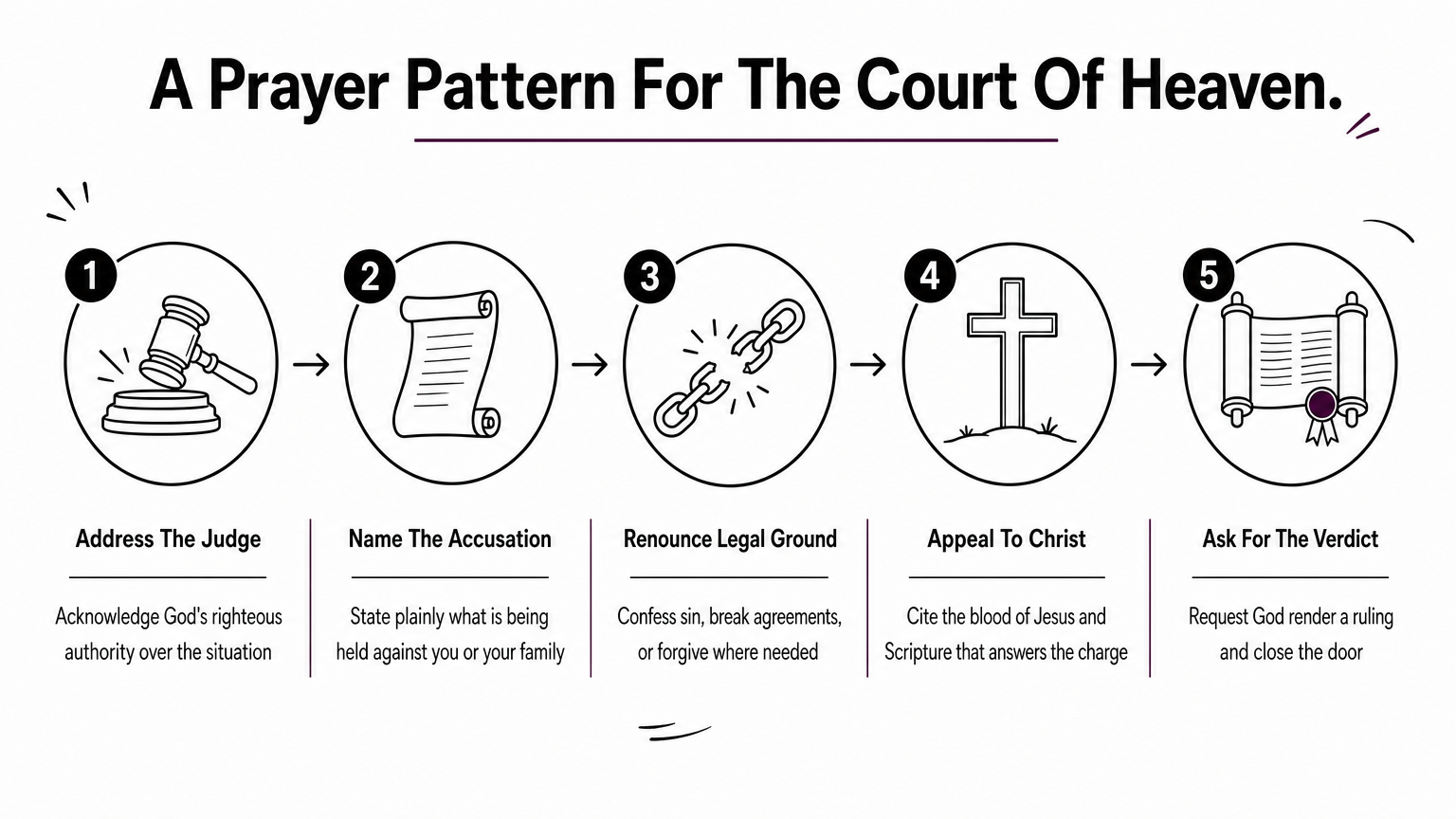
A simple prayer pattern to follow
Many believers find it helpful to move through a consistent structure rather than praying in circles. Try this pattern the next time you sit down to pray this way:
- Address the Judge directly. Acknowledge God's righteous authority over the situation.
- Name the accusation. State plainly what you believe is being held against you or your family.
- Renounce any legal ground. Confess sin, break agreements, or forgive where needed.
- Appeal to Christ's finished work. Cite the blood of Jesus and specific Scripture that answers the charge.
- Ask for the verdict. Request that God, as Judge, render a ruling and close the door the accusation opened.
This pattern isn't a script to recite word-for-word every time; it's scaffolding for before the court of heaven prayer that keeps you focused instead of repeating vague requests. If you'd rather walk through this with structured lessons, prompts, and journaling instead of building it alone, the Defense Protocol course in biblical intercession breaks each step into a guided module, so you're never guessing what comes next.
Common questions and cautions about this teaching
Every growing prayer practice attracts questions, and this one is no exception. Mothers often ask whether court of heaven language is a recent trend dressed up in spiritual talk, or whether it holds up against sound doctrine. The honest answer is both simpler and more reassuring than the debate online suggests: the core idea is thoroughly biblical, even though some popular teaching around it has drifted into excess.
Is this a new trend or an old truth?
Skeptics sometimes dismiss courtroom prayer as a modern fad, but the biblical record says otherwise. Daniel, Job, and Zechariah all describe this courtroom centuries before any contemporary ministry coined a catchy phrase for it. What's new is the vocabulary some teachers use, not the underlying reality Scripture already names. When you stick close to the court of heaven bible verses themselves rather than secondhand teaching, you stay grounded in text rather than trend.
Does this replace normal prayer and repentance?
Nothing about this framework replaces ordinary petition, worship, or repentance. Courtroom language describes one dimension of prayer, not the whole of it. You still ask your Father for daily bread, still confess sin plainly, still thank him without needing a legal frame for every moment. Treat this teaching as an additional lens for specific stuck situations, not a replacement for the relational prayer you've always practiced.
A courtroom is one room in your Father's house. Don't move in and forget the rest of the home exists.
Cautions worth taking seriously
Guarding against distortion matters as much as understanding the teaching itself. Keep these boundaries in mind as you pray this way:
- Avoid treating it as a formula. No sequence of words guarantees a specific outcome; God remains sovereign, and Warrior Mom never claims a prayer pattern controls his answer.
- Don't over-legalize ordinary hardship. Not every illness or delay signals a courtroom accusation; sometimes life is simply hard in a fallen world.
- Never bypass real help. This practice complements pastoral counsel, licensed mentorship, and professional care rather than replacing them.
- Stay Scripture-anchored. If a teaching adds details Daniel, Job, or John never mention, hold it loosely.
Framing these cautions honestly protects the teaching's credibility rather than undermining it. Mothers who approach the court of heaven scripture with both confidence and humility tend to pray with the most lasting peace, neither dismissing the courtroom as fiction nor treating it as a magic key. If you want structured guidance that keeps these guardrails in place while still teaching the full biblical picture, Warrior Mom's Court of Heaven Defense Protocol was built with exactly this balance in mind.
Carrying this truth into your prayer life
Understanding the court of heaven doesn't hand you a magic formula, but it does hand you clarity. You now know God sits as righteous Judge, Satan brings accusation rather than authority, and Christ stands as your advocate with a case already won. That knowledge changes how you approach the situations that have felt stuck for months or years. You stop begging in the dark and start presenting settled truth to a Judge who welcomes you at his throne.
Next time you sit down to pray over your child, your marriage, or your own weary heart, remember this framework and let it shape your words. Scripture gave you the courtroom language for a reason: so you'd pray with confidence, not confusion. If you want to keep building this practice with structured lessons and journaling prompts, choose your Warrior Mom membership level and start walking through it step by step this week.